

Early clients of General Legal find our contract review service "magical". Founders and operators get sales contracts turned in hours and they get practical, real-time legal advice from exceptionally talented attorneys. It all happens over Slack. Their deals close much faster and they have a great attorney on their side to usher them through legal.
What makes our service magical is the AI-native law firm model behind it. That model isn't magic. It's a combination of sophisticated contract AI, boring operational technology, and leveraging talent density.
Technology
Most of our clients work directly with us over Slack. Each client's private Slack channel is monitored by bots that detect new client requests, trigger our contract AI workflows, and schedule attorney time for review.
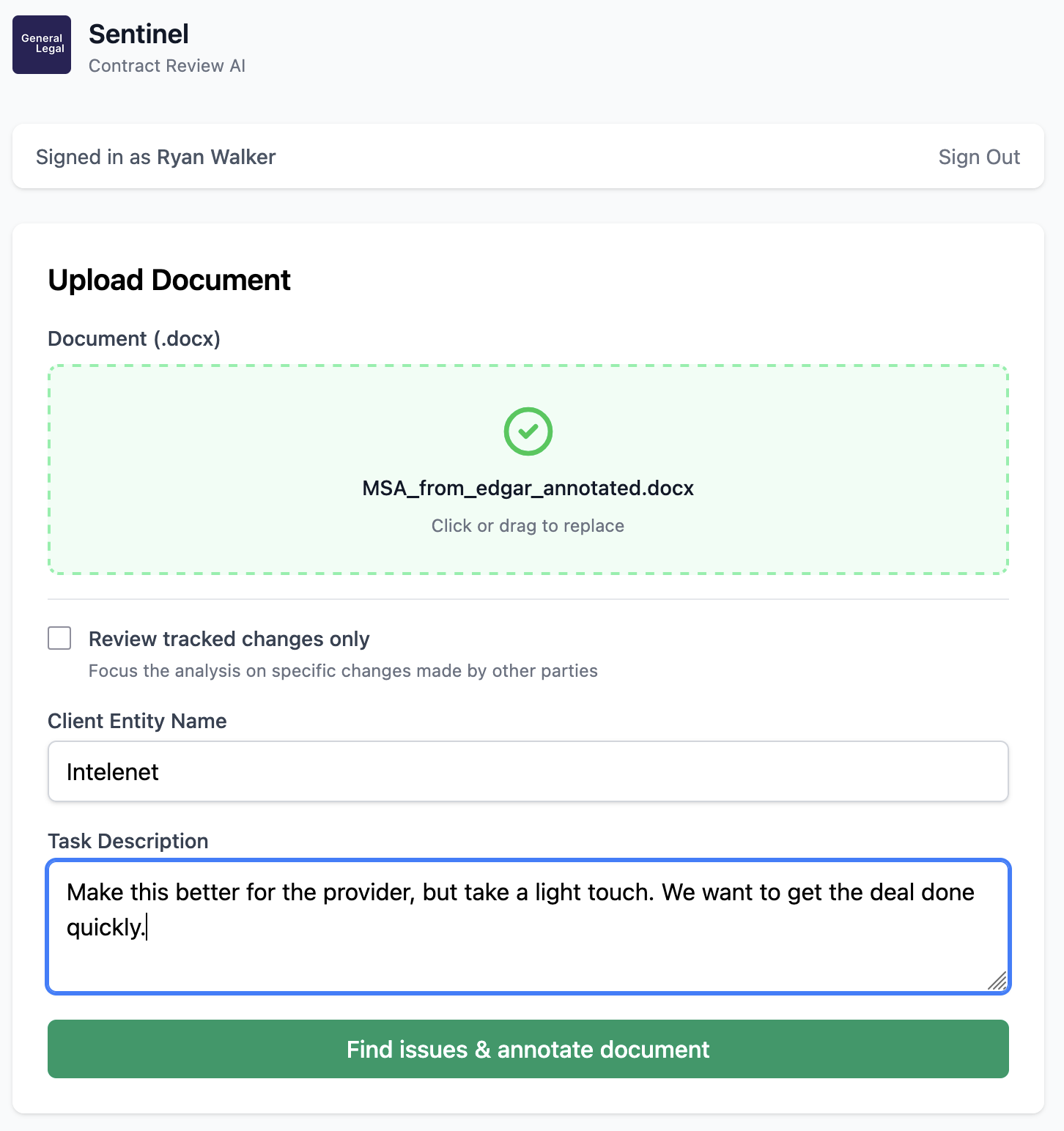
Our contract AI (which we call Sentinel) is built on a few simple ideas:
- State of the art LLMs are good at issue detection, redlining, and annotation
- The best LLM agents are bad at interpreting client needs, leverage, and defining strategy for deals
- LLM world models do not know what's market and LLMs are both overconfident in their market knowledge and over-aggressive in their mark-ups
- The best human attorneys are really good at 2 and 3 and often not particularly great at 1.
We turned these ideas into General Legal's core internal contract review workflow:
- Sentinel AI always takes the first pass over a contract, guided optionally by an attorney defined strategy
- Sentinel creates redlines, annotations, and issues lists. These lists are overly inclusive, sometimes misinterpret market, and don't fully align to the client strategy
- After Sentinel finishes its review (in about ten seconds), our attorneys take over reviewing the full contract as well as the AI's markup.

Humans
Experienced attorneys can typically do a post-Sentinel review in about 15-30 minutes, a compression of several hours of formerly billable work. The AI related human acceleration comes from three sources:
- having all issues clearly marked in the document with concise explanations
- having many redlines and comments pre-built that the attorney can edit
- having full client context (including prior contracts) in AI memory and easily accessible to the attorney through our tooling
Human acceleration also comes from several non-AI factors built into our workflow:
- Contract review happens in _only one place._ Microsoft Word. This keeps the attorney fully focused on the actual contract document that gets turned back to the client. We built a specialized Word add-in to add additional AI capabilities to the review without pulling the attorney into another tool
- Great UX is the standard for any tool an attorney uses
- Automation around every handoff point. Bots and agents manage our scheduling, and notification, eliminating hours of lost productivity in the email driven workflows of traditional law firm contract review
Talent
The best traditional law firms are phenomenal managers of talent. Talent is core to the identity of law firms, built into their apprenticeship models, and a point of fierce competition. We think the best AI-native law firms will be the ones that can also hire the best attorneys and AI engineers. Good engineers and good attorneys already deliver 10x+ leverage multiples over bad ones. In the AI-native model, the leverage of these already high-leverage people can be massively compounded. Well-run AI-native companies should trend towards at least 100x employee leverage.
How does a new AI-native law firm win the kind of talent that can deliver those multiples? We're drawing a couple lessons from traditional law firms:
- Hire people to work on something that matters. Law matters and good lawyers became lawyers to work on important things.
- Giving real ownership stakes to top talent yields exceptional outcomes.